Incorporating high paying keywords into your site is critical to maximizing your income. Who has the time to figure it all out? How much are you willing to pay for this type of information? The secret is out: Here are 99 keywords you can use with payouts averaging $2-$100 per click:

1. Structured settlements

2. Mesothelioma

3. Acne

4. Life Insurance

5. Death Insurance

6. Bextra

7. Asbestos

8. Car Insurance

9. Dental Plans

10. Private Jets

11. Debt Consolidation

12. Credit Cards

13. Rewards Cards

14. Equity Loans

15. Equity Line Credit

16. Loans

17. Mortgages

18. Pay Day Loans

19. Cash Advance

20. Bankruptcy

21. Reduce Debt

22. Refinance

23. Jet Charter

24. Vioxx

25. Wrongful death

26. Legal Advice

27. Taxes

28. Investing

29. Bonds

30. Online Trading

31. IRA Rollover

32. Refinance Quotes

33. Adult Education

34. Distance Learning

35. Alcohol Treatment

36. Rehab

37. Drug Rehab

38. Spyware

39. Cell Phone Plans

40. Calling Cards

41. VOIP

42. Weight Loss

43. Canadian Pharmacy

44. Depression

45. Spam Filter

46. Lasik

47. Facelift

48. Teeth Whitening

49. Annuity

50. Anti Virus Protection

51. Adult Diaper

52. Free Credit Report

53. Credit Score

54. Satellite

55. Anti Spam Software

56. Dedicated Hosting

57. Domain Name

58. Need Money

59. Bachelor Degree

60. Master Degree

61. Doctorate Degree

62. Work at Home

63. Quick Book

64. Extra Money

65. Eloan

66. Malpractice Lawyer

67. Lenox China

68. Cancer

69. Payperclick

70. Personal Injury Attorney

71. Lexington Law

72. Video Conferencing

73. Transfer Money

74. Windstar Cruise

75. Casinos Online

76. Term Life

77. Online Banking

78. Borrow Money

79. Low Interest Credit Cards

80. Personal Domain Name

81. Cellular Phone Rental

82. Internet Broker

83. Trans Union

84. Cheap Hosting

85. University Degrees Online

86. Online Marketing

87. Consolidate

88. Helpdesk Software

89. Web Host

90. Homeowner's Insurance

91. Yellow Page Advertising

92. Travel Insurance

93. Register Domain

94. Credit Counseling

95. Email Hosting

96. Business Credit

97. Consumer Credit

98. Blue Cross

99. Laptop Computer

Adsense Quick Start Guide

Posted by admin | 4:04 AM

Hi readers..


This is another tips from Adsense Team. It is a quick start guide once your AdSense application has been approved. You can follow this guide to get started with AdSense right away. The steps below will help you add an AdSense ad unit to your site.

1. Sign into your account and choose the AdSense Setup tab. On the Get Ads page, click the AdSense for Content link to create a standard Google ad unit.


2. Next, select the ad type. Since you'll be creating a standard ad unit, choose the Ad Unit radio button. To enable the widest selection of ads to display on your pages, leave the drop-down set to Text and image ads (default).


3. Now, take a moment to customize your ads so they'll match the look and feel of your site. Select the size you'd like from one of our different ad formats, keeping in mind that larger and wider ad units tend to perform better. (Get tips on picking a format.)


4. Next, select colors for your ads. You choose one of our predefined color palettes or create your own. You can view a sample of how the ads will look based on the colors you've selected. This is the tips to choose colors.


5. If you're interested in tracking the performance of your ad unit, you can add a channel. Channels provide more granular reports for the performance of specific ad units. If you haven't created a channel yet, you can skip this step by clicking Continue.


6. Next you'll be prompted to name your AdSense ad unit. This will allow you to change the appearance or settings of your ad easily through your account in the future, so select a name that will allow you to easily identify this AdSense unit later. For more information about this feature, check out the guide to Managing your Ads.


7. Finally, you will be provide with the ad code for your AdSense ad unit. Click anywhere inside the grey box to select the code, then right-click and select copy. You can now paste the code into the HTML source code of your site. For details and assistance adding the code to your pages, please review the Code Implementation guide.

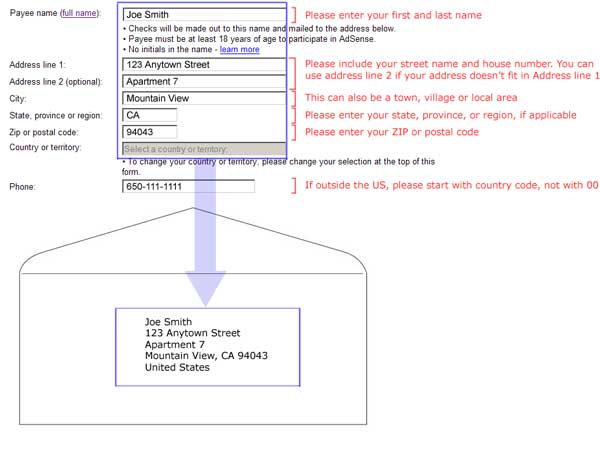
1. How should I enter my payee name and address?

Google had provided an example below that may help you determine how to fill in your name and address in the fields on the application form. Keep in mind that the address below is simply an example, and you should provide your address accurately to conform to postal requirements in your location.


2. How do I change my payee information?

In order to protect your account, the payee name cannot be changed. program policies also do not allow the transfer of accounts. If you need to change your payee name for any reason, please fill out the change of payee name form.

Before you fill out the form, you should be aware of a few things:

  • According to program policies, AdSense accounts cannot be transferred or sold. If this is your reason for requesting the change, you will not be able to update your payee name.
  • You won't be able to change your payee name if you already have another AdSense account under that name.
  • Once Google updated your information, you'll need to re-enter your tax information and form of payment.
  • If you've received a payment to the old payee name that you're unable to deposit, you'll need to request a reissue after the 25th of the month following your payment.
  • The payments will be process on the 16th of each month. If you're scheduled to receive a payment this month and the payee name in your account is updated after the 16th, your payment will be issued to your old name.
3. What if my full name doesn't fit in the application page?

The 'Payee Name' field on the AdSense application is limited to 35 characters. If your payee name is longer than this, please enter your first initial and complete last name.

Right from the resource

Posted by admin | 4:02 AM

Google have introduced a new tab in Adsense's account - A new Resources tab. Now, you can easily keep track of all the official AdSense-related documentation online. Here is how the resources page look like:


A number of resources are compiled under this tab, including the Help Center, Program Policies, and Help Forum. If you're looking to improve the performance of your ads, you can now easily navigate to Optimization Tips page or to publisher tools like Analytics.

If you need help with implementing your ad code or viewing your ads, you can try the Demos & Guides or Troubleshooting Wizards, all available under the Resources tab.

What is PSA ?

PSAs or Public Service Ads are non-profit organization ads that are served to pages when targeted ads are unavailable, or when Google is unable to gather content from the page. Publishers do NOT receive earnings for clicks made on PSAs.

Here is one of the examples of adsense public service ads you may get.

adsense-public-service-ads
Public Service Ads

Why am I getting PSAs ?

There can be many reasons why a website may display less targeted ads or public service ads. Below is a list of the most common issues.

  • Google's system has not yet crawled all the pages of your website.
    - The crawler needs more time. If Google has not previously crawled your site, it may take up to 48 hours or more to gather the content of that page. In the meantime, the ads you see may be public service ads or ads that are only slightly relevant. The relevance will increase over time.
    Note: Cawler indexes by URL and therefore considers http://site.com and http://www.site.com different URLs. Because it will visit these URLs separately, you may notice ads appear differently on these pages.
    - The crawler can't reach your site. If the crawler isn't able to access your page, you will see an error message on the Site Diagnostics page of your account. For more details on these errors and how to resolve them, please go here: Site Diagnostics entry.

  • Your page may contain sensitive content for which relevant paying ads will not be displayed.
    Google system has certain filters in place to protect the advertisers from advertising on pages that could be construed as potentially negative, non-family safe or even offensive. Although the nature of your content may not fit into any of these categories, at times the emphasis of some sensitive subject matters on a page can flag the servers to deliver public service ads to a page.

  • Your account may be disapproved or awaiting review.
    To determine the status of your application, please try to log in at www.google.com/adsense using the email address and password you submitted with your application.
    • If you see a message stating: Account Not Active: An AdSense account does not exist for this login, as it is associated with an unapproved application., search your email to find the disapproval or account closure message for more information.
    • If you've applied to AdSense through another website, such as Blogger, you may be displaying ads even though your application is unreviewed or has been disapproved.
      • If you see a message stating Account Not Active: An AdSense account does not exist for this login, as your application is currently in review., please wait 2-3 days because your application is under review.
      • If you see another message or form, search your email to find the disapproval message for more information.
    • If you successfully log into your account, this reason doesn't apply to you.
  • Your site has restricted access using a robots.txt exclusion.
    If your site is using a robots.txt file, the AdSense crawler may be blocked from crawling your webpages. Therefore, your site can't get the most relevant ads based on the content of your website. On pages the crawler unable to crawl or understand the content of a page, public service ads may be displayed, for which you will not receive any earnings.

    For more information on the robots protocol, please visit http://www.robotstxt.org.

  • Your website is using session IDs in the URL.
    If your webpages use session IDs, you may not receive targeted ads on those pages. Since this session ID - and therefore the URL - changes every time a different user views a page, the URL will not be in the index and will be queued to be crawled. Once the URL is crawled, however, the session will most likely have expired. This means that pages seen by the users are never in the index. You will need to remove the session IDs in order to display targeted ads.

  • Your website is using frames.
    Google AdSense crawlers are unable to match ads to your webpage content when the AdSense ad code is placed in a frame separate from the primary content of your website. It is important to place the ad code in the same frame as the content of your webpages in order to serve ads targeted to your webpage content.

  • Your ad unit is set to display image ads only.
    Image ad inventory for your content may be limited at this time; PSAs will be displayed in that unit when there are no relevant image ads available. To avoid showing PSA's, please update your preferences to show both text and image ads or implementing an alternate ad.

  • Your webpage may not contain enough content.
    There may not be enough information on your site for Adsense crawlers to determine the content of your pages. Therefore, it is a bit difficulty to identify relevant ads to show on your pages. Please note that the crawlers are unable to derive meaning from:

    * audio and video files (.wma, .mpeg, .mov)
    * mp3 files (.mp3)
    * images (.jpeg, .bmp)
    * Macromedia Flash movies
    * Java Applets

    In such cases, you need to include more content other than the above files on your website to assist the crawlers in gathering information about your site to display relevant ads.

  • The AdSense ad code was placed within an IFRAME.

  • Your webpages are behind a login.
    At this time, pages that require a login can not be easily visited by Adsense crawlers. Additionally, since these types of pages are not easily visited for approval and it is difficult for AdSense specialists to verify that pages behind a log in follow Google AdSense policies.

  • There are too many URLs added to your account filter list.
    At times, if you add too many URLs to your filter list, there might be no longer other ads available to target to your content. As a result, you may begin seeing less relevant or public service ads on your webpages.

  • Your site content is primarily in an unsupported language.
    If the AdSense code is placed on pages with content primarily in an unsupported language, public service ads or ads in another language will appeared. You can refer to program policies, publishers may not display ads on pages with content primarily in an unsupported language, so please remove the ad code from these pages until we're able to support your language.

  • Your ad code has been modified
    If the AdSense code has been manually modified, such as to change the ad unit width or height or the publisher ID. Please select the desired ad format on the AdSense Setup tab of your account and then paste the generated ad code, unedited, onto your pages. Keep in mind that modifications to your code are not permitted by our program policies.

Google AdSensePeople always think that they can join Adsense easily but what most happen is, Google easily rejected their application because of some reason. So, to help make sure your application is approved the first time around, ask yourself the following questions below before submitting.

Do I have what I need to apply?

  • Website: To display Google ads, you need administrative access to the site you submit for AdSense in order to place our JavaScript ad code on your site. Adding the Google code to your site's source code will enable you to show ads, search boxes, and referral units on your pages.

    If you don't have a website of your own, that doesn't mean you can't participate in AdSense. There's Blogger, a free tool for setting up and publishing your own blog online. With its easy-to-use and customizable templates, you can create an account and start blogging right away. You can also set up AdSense ads easily through your Blogger account.

    If you prefer more flexibility and control, then our web page tool, Page Creator, may be more suitable. Signing up for a Page Creator account is free as well -- all you need is a Gmail account. The best part is that you don't have to download any software or hire a designer. Once you've created your Page Creator site, you can begin displaying Google ads in minutes.

  • Valid payee name: Payments will be made out to the name on your account, so make sure to include your full and valid name, or that of your business, rather than just initials. This is the most important thing you should do because whenever Payee name have been filled, you can't change it anymore. And if there is error on the payee name, you can't clear your check because bank will reject it due to the error.

  • Valid address: Google want to make sure your hard-earned money reaches you, so please also provide a complete valid address where you can receive mail. If you live in a country or territory that doesn't have a standard format for addresses, please be sure that your application includes as much information as a mailman would need to find your residence.
Does my website meet all the necessary requirements?
  • Valid URL: If you manage an entire website, give the URL of your home page. If you manage a blog or other account within a larger website, you should provide the URL of the specific page that you manage and not the URL of the entire hosting website. Don't forget to double check your URL for typos!

  • Fully launched website: Since Google won't be able to review websites that are not fully launched or built, please ensure that your site is live and functioning at the time you submit your application.

  • Unique content: Google want visitors to sites in the AdSense network to have a good experience, so please publish content that's interesting and unique. Avoid using "doorway" pages created just for search engines, or other cookie cutter approaches such as affiliate programs with little or no original content. If you're participating in an affiliate program, give people a reason to visit your site first.

  • Supported language: Google only approve your application if the majority of your website is in one of our supported languages.

  • Pay-To Sites: If your site participates in programs that compensate people to perform activities that drive traffic to you, Google can't approve your application. Some examples of these "pay-to" programs are sites that encourage users "to click" or "to surf" or "to read email." In addition, you shouldn't encourage others to join these programs in the content, links, or third-party ads on your site.
Read Adsene's program policies in detail for further insight on how to create a successful application.

What on earth happen with adsense now. Seems that they are continually looking for ways to put the kabosh on click fraud. It is important that they protect the rights of their advertisers by making sure each click is an intentional click. That is, they want to be certain that the person clicking the ad is doing so deliberate. Otherwise, the advertiser is paying for a visit that is not purposeful.

The news leak out from a number of blogs that Google is getting ready to make a change to the way Adsense ads are clicked. Many people are concerned that this change is going to affect their AdSense earnings.

Let's take a look of what they have change recently.

From the beginning, a click anywhere within the region of an ad would result in a successful clickthrough to the sponsor site. This image highlights where an ad could be clicked in order to count as a clickthrough.

click1.jpg

However, with the upcoming changes, Google is only allowing the clickthrough to take place if the visitor clicks the title or the url of the advertisement, not the description text nor surrounding areas.

This image highlights the change that is coming.

click2.jpg

Why is Google doing this?

In all likelihood, there is a percentage of clicks that are the result of accidental clicking. A page load and the mouse may stray to a portion of the ad and get clicked unintentionally. Google wants to prevent this from happening as it costs the advertiser money without providing the intended result, and that is a visitor who is wanting to visit the advertiser site.

What does this mean to advertisers?

It means they are likely to receive fewer visitors and more value per visitor. This is exactly what they want.

What does it mean to the AdSense publisher?

Most likely, it means your AdSense revenue will fall somewhat. How about the CTR? Honestly, I don't expect any major changes in CTR. Accidental clicks still may happen but I've got to believe that most people are clicking ads on purpose. And if they click the description text and nothing happens, most people will try again by clicking the ad title. After all, it is a hyperlink and I would think the vast majority understand that is where you are supposed to click.

Of course, we won't know for sure until the change takes place, but I don't expect to see any major changes in revenue. Besides, if this change is good for advertisers, they will have more money to spend on ads. And you know what that means.

Google AdSense program can reap even richer dividends for you if you are able to attract more visitors to your website and if you are able to prompt them to take action (i.e. click on the AdSense Ads). Google disallows statements that ask the visitors to click on the AdSense Ads. In fact, Google AdSense Ads are to be marked in some way as advertisements. However, there are other authentic ways of getting the clicks on your AdSense Ads.

Besides the copy and quality content, you can also improve the performance of your AdSense Ads by either making them blend with your website or making them standout. The aim is to make the AdSense Ads more attractive/ appealing to your website visitors and to make them look in-place (not out of place). Google too recognizes this need and hence it provides you with customization options for making the Ads look the way you want them to.

You can make the AdSense Ads suit your website by controlling the shape, size, color and positioning of the Ads. Let’s have a brief look at the first two properties i.e. shape and size:

1. Shape of your AdSense Ads: This is one of the most important customizations options that you have at your disposable. You can make your selection from a number of Ad formats that Google makes available to you. These include skyscrapers, single ad blocks and banners. Just check the suitability of the shape with respect to the webpage where you wish to include the AdSense Ad.

2. Size of your AdSense Ads: Again, you can use AdSense Ads of various sizes. The size is important not only for making the Ads look suited to your website but also for determining the number of Ads that can be displayed on the webpage by the Google AdSense program. A large size generally means that more Ads can be displayed on the page (and hence presents the opportunity for earning more revenue with increased impressions).

Think outside the ad unit

Posted by admin | 3:50 AM

My respective readers,

Have you try to use link ads unit? I am asking this question because today i will reveal a secret on how to use link ads unit in a better ways so that it will improve your adsense earning everyday.

Each link unit displays a list of topics relevant to the content of your site, and when users click on one of these topics, they're brought to a page of AdWords ads related to that topic. Though you won't receive earnings for clicks on the topics, you'll be paid for user clicks on any of the AdWords ads on the resulting page.

Link Unit

Link units are particularly effective for more focused content, where visitors tend to be seeking specific information. Their varied formats are space-efficient, too, so I suggest incorporating link units into new and unusual locations throughout your site. Remember that three link units per page can be placed in addition to the existing three standard AdSense ad units on that page.

Can I click on the link units in my site ?

AdSense publishers are permitted to click on link unit topics on their webpages, provided that they do not click on any Google ads on the resulting page. Clicking on the ads themselves is prohibited, as it has the potential to inflate advertiser costs.

However, you may still prefer not to click on the link unit topics that appear on your site, as clicking on these links has the potential to inaccurately inflate impressions and affect your reporting metrics.

How do I add link units to my page?

AdSense publishers can add a up to three link units to any of their content pages that conform with our program policies. Adding a link unit is as easy as pasting a block of code into the source of your pages - follow the directions below to start showing this new form of text advertising on your website:

  1. Log in to your AdSense account at www.google.com/adsense
  2. Click the AdSense Setup tab and choose AdSense for content as the product.
  3. Select the link unit radio button and continue.
  4. From the Format drop-down list, select a link unit format and choose the radio button for showing 4 or 5 links per unit.
  5. Select your color palette and assign a channel and alternate ad to your ad unit, if desired.
  6. Copy and paste the ad code from the Your AdSense Code box into the source of your web pages. Please make sure that you copy the code in its entirety, and that you paste it into the body of your source.

Once you've updated your pages, link units will appear immediately. If we haven't yet crawled your page, we may initially show your alternate ad or a 'View ads about' search box in the link unit.

Google is continuously trying different ways to improve the earnings of their AdSense ad units. One of the things they’ve been doing recently is embedding link units right into regular ad units, efficiently integrate the two into a hybrid kind of ad unit. Here’s what it looks like, a screenshot taken from this very blog over the weekend:

You won’t see these too often. Google does split testing on these kinds of changes to see if they work or not. Sad to say, there is no way for you to opt out of these tests, which means that any AdSense publisher can become a guinea pig for Google’s experimentation. Other publishers have reported being strained to display CPA (cost per action) ads, for example.

In any case, if you doubt why your ads look different sometimes, that’s why… if these hybrid ads prove to be successful, expect them to be rolled out across the network. They might be made optional in that case. (And they really only work with the banner ads — they need lots of horizontal space.)

Earn $$ with WidgetBucks!

Here come a new money-making service that bloggers and other webmasters are starting to use is something similar to Chitika called WidgetBucks. It is a new advertising network that PPC program which mean that you will get paid everytime someone clicks on the little widget.

Earn $$ with WidgetBucks

Since the advertising network is pretty new, there is no reason for bloggers or webmasters to turn this down. One of the cool things about it is its CPM of $3-$5. Plus, if you are new to WidgetBucks and register, you automatically get $25 in your account. The minimum payout is just like Auctionads ( $50 ) so you need another $25 before you can get your first payment. Sound good enough compared to the long-waited of Google Adsense when you need to wait until your account reach $100 before getting paid. So let's go for it !!

If you haven't signed up yet, go ahead and do so now. If other monetization strategies did not work for you, having another one with WidgetBucks might help.

Sign up Widgetbucks and get $25 sign-up bonus

Google is clearly the best general-purpose search engine on the Web (see

www.pcmag.com/searchengines

But most people don't use it to its best advantage. Do you just plug in a keyword or two and hope for the best? That may be the quickest way to search, but with more than 3 billion pages in Google's index, it's still a struggle to pare results to a manageable number.

But Google is an remarkably powerful tool that can ease and enhance your Internet exploration. Google's search options go beyond simple keywords, the Web, and even its own programmers. Let's look at some of Google's lesser-known options.

Syntax Search Tricks

Using a special syntax is a way to tell Google that you want to restrict your searches to certain elements or characteristics of Web pages. Google has a fairly complete list of its syntax elements at

www.google.com/help/operators.html

. Here are some advanced operators that can help narrow down your search results.

Intitle: at the beginning of a query word or phrase (intitle:"Three Blind Mice") restricts your search results to just the titles of Web pages.

Intext: does the opposite of intitle:, searching only the body text, ignoring titles, links, and so forth. Intext: is perfect when what you're searching for might commonly appear in URLs. If you're looking for the term HTML, for example, and you don't want to get results such as

www.mysite.com/index.html

, you can enter intext:html.

Link: lets you see which pages are linking to your Web page or to another page you're interested in. For example, try typing in

link:http://www.pcmag.com


Try using site: (which restricts results to top-level domains) with intitle: to find certain types of pages. For example, get scholarly pages about Mark Twain by searching for intitle:"Mark Twain"site:edu. Experiment with mixing various elements; you'll develop several strategies for finding the stuff you want more effectively. The site: command is very helpful as an alternative to the mediocre search engines built into many sites.

Swiss Army Google

Google has a number of services that can help you accomplish tasks you may never have thought to use Google for. For example, the new calculator feature

(www.google.com/help/features.html#calculator)

lets you do both math and a variety of conversions from the search box. For extra fun, try the query "Answer to life the universe and everything."

Let Google help you figure out whether you've got the right spelling—and the right word—for your search. Enter a misspelled word or phrase into the query box (try "thre blund mise") and Google may suggest a proper spelling. This doesn't always succeed; it works best when the word you're searching for can be found in a dictionary. Once you search for a properly spelled word, look at the results page, which repeats your query. (If you're searching for "three blind mice," underneath the search window will appear a statement such as Searched the web for "three blind mice.") You'll discover that you can click on each word in your search phrase and get a definition from a dictionary.

Suppose you want to contact someone and don't have his phone number handy. Google can help you with that, too. Just enter a name, city, and state. (The city is optional, but you must enter a state.) If a phone number matches the listing, you'll see it at the top of the search results along with a map link to the address. If you'd rather restrict your results, use rphonebook: for residential listings or bphonebook: for business listings. If you'd rather use a search form for business phone listings, try Yellow Search

(www.buzztoolbox.com/google/yellowsearch.shtml).


Extended Googling

Google offers several services that give you a head start in focusing your search. Google Groups

(http://groups.google.com)

indexes literally millions of messages from decades of discussion on Usenet. Google even helps you with your shopping via two tools: Froogle
CODE
(http://froogle.google.com),

which indexes products from online stores, and Google Catalogs
CODE
(http://catalogs.google.com),

which features products from more 6,000 paper catalogs in a searchable index. And this only scratches the surface. You can get a complete list of Google's tools and services at

www.google.com/options/index.html

You're probably used to using Google in your browser. But have you ever thought of using Google outside your browser?

Google Alert

(www.googlealert.com)

monitors your search terms and e-mails you information about new additions to Google's Web index. (Google Alert is not affiliated with Google; it uses Google's Web services API to perform its searches.) If you're more interested in news stories than general Web content, check out the beta version of Google News Alerts

(www.google.com/newsalerts).

This service (which is affiliated with Google) will monitor up to 50 news queries per e-mail address and send you information about news stories that match your query. (Hint: Use the intitle: and source: syntax elements with Google News to limit the number of alerts you get.)

Google on the telephone? Yup. This service is brought to you by the folks at Google Labs

(http://labs.google.com),

a place for experimental Google ideas and features (which may come and go, so what's there at this writing might not be there when you decide to check it out). With Google Voice Search

(http://labs1.google.com/gvs.html),

you dial the Voice Search phone number, speak your keywords, and then click on the indicated link. Every time you say a new search term, the results page will refresh with your new query (you must have JavaScript enabled for this to work). Remember, this service is still in an experimental phase, so don't expect 100 percent success.

In 2002, Google released the Google API (application programming interface), a way for programmers to access Google's search engine results without violating the Google Terms of Service. A lot of people have created useful (and occasionally not-so-useful but interesting) applications not available from Google itself, such as Google Alert. For many applications, you'll need an API key, which is available free from
CODE
www.google.com/apis

. See the figures for two more examples, and visit

www.pcmag.com/solutions

for more.

Thanks to its many different search properties, Google goes far beyond a regular search engine. Give the tricks in this article a try. You'll be amazed at how many different ways Google can improve your Internet searching.


Online Extra: More Google Tips


Here are a few more clever ways to tweak your Google searches.

Search Within a Timeframe

Daterange: (start date–end date). You can restrict your searches to pages that were indexed within a certain time period. Daterange: searches by when Google indexed a page, not when the page itself was created. This operator can help you ensure that results will have fresh content (by using recent dates), or you can use it to avoid a topic's current-news blizzard and concentrate only on older results. Daterange: is actually more useful if you go elsewhere to take advantage of it, because daterange: requires Julian dates, not standard Gregorian dates. You can find converters on the Web (such as

CODE
http://aa.usno.navy.mil/data/docs/JulianDate.html

excl.gif No Active Links, Read the Rules - Edit by Ninja excl.gif


), but an easier way is to do a Google daterange: search by filling in a form at

www.researchbuzz.com/toolbox/goofresh.shtml or www.faganfinder.com/engines/google.shtml

. If one special syntax element is good, two must be better, right? Sometimes. Though some operators can't be mixed (you can't use the link: operator with anything else) many can be, quickly narrowing your results to a less overwhelming number.

More Google API Applications

Staggernation.com offers three tools based on the Google API. The Google API Web Search by Host (GAWSH) lists the Web hosts of the results for a given query

(www.staggernation.com/gawsh/).

When you click on the triangle next to each host, you get a list of results for that host. The Google API Relation Browsing Outliner (GARBO) is a little more complicated: You enter a URL and choose whether you want pages that related to the URL or linked to the URL

(www.staggernation.com/garbo/).

Click on the triangle next to an URL to get a list of pages linked or related to that particular URL. CapeMail is an e-mail search application that allows you to send an e-mail to google@capeclear.com with the text of your query in the subject line and get the first ten results for that query back. Maybe it's not something you'd do every day, but if your cell phone does e-mail and doesn't do Web browsing, this is a very handy address to know.

Fatal error: the system has become unstable or is busy," it says. "Enter to return to Windows or press Control-Alt-Delete to restart your computer. If you do this you will lose any unsaved information in all open applications."

You have just been struck by the Blue Screen of Death. Anyone who uses Mcft Windows will be familiar with this. What can you do? More importantly, how can you prevent it happening?

1 Hardware conflict

The number one reason why Windows crashes is hardware conflict. Each hardware device communicates to other devices through an interrupt request channel (IRQ). These are supposed to be unique for each device.

For example, a printer usually connects internally on IRQ 7. The keyboard usually uses IRQ 1 and the floppy disk drive IRQ 6. Each device will try to hog a single IRQ for itself.

If there are a lot of devices, or if they are not installed properly, two of them may end up sharing the same IRQ number. When the user tries to use both devices at the same time, a crash can happen. The way to check if your computer has a hardware conflict is through the following route:

* Start-Settings-Control Panel-System-Device Manager.

Often if a device has a problem a yellow '!' appears next to its description in the Device Manager. Highlight Computer (in the Device Manager) and press Properties to see the IRQ numbers used by your computer. If the IRQ number appears twice, two devices may be using it.

Sometimes a device might share an IRQ with something described as 'IRQ holder for PCI steering'. This can be ignored. The best way to fix this problem is to remove the problem device and reinstall it.

Sometimes you may have to find more recent drivers on the internet to make the device function properly. A good resource is www.driverguide.com. If the device is a soundcard, or a modem, it can often be fixed by moving it to a different slot on the motherboard (be careful about opening your computer, as you may void the warranty).

When working inside a computer you should switch it off, unplug the mains lead and touch an unpainted metal surface to discharge any static electricity.

To be fair to Mcft, the problem with IRQ numbers is not of its making. It is a legacy problem going back to the first PC designs using the IBM 8086 chip. Initially there were only eight IRQs. Today there are 16 IRQs in a PC. It is easy to run out of them. There are plans to increase the number of IRQs in future designs.

2 Bad Ram

Ram (random-access memory) problems might bring on the blue screen of death with a message saying Fatal Exception Error. A fatal error indicates a serious hardware problem. Sometimes it may mean a part is damaged and will need replacing.

But a fatal error caused by Ram might be caused by a mismatch of chips. For example, mixing 70-nanosecond (70ns) Ram with 60ns Ram will usually force the computer to run all the Ram at the slower speed. This will often crash the machine if the Ram is overworked.

One way around this problem is to enter the BIOS settings and increase the wait state of the Ram. This can make it more stable. Another way to troubleshoot a suspected Ram problem is to rearrange the Ram chips on the motherboard, or take some of them out. Then try to repeat the circumstances that caused the crash. When handling Ram try not to touch the gold connections, as they can be easily damaged.

Parity error messages also refer to Ram. Modern Ram chips are either parity (ECC) or non parity (non-ECC). It is best not to mix the two types, as this can be a cause of trouble.

EMM386 error messages refer to memory problems but may not be connected to bad Ram. This may be due to free memory problems often linked to old Dos-based programmes.

3 BIOS settings

Every motherboard is supplied with a range of chipset settings that are decided in the factory. A common way to access these settings is to press the F2 or delete button during the first few seconds of a boot-up.

Once inside the BIOS, great care should be taken. It is a good idea to write down on a piece of paper all the settings that appear on the screen. That way, if you change something and the computer becomes more unstable, you will know what settings to revert to.

A common BIOS error concerns the CAS latency. This refers to the Ram. Older EDO (extended data out) Ram has a CAS latency of 3. Newer SDRam has a CAS latency of 2. Setting the wrong figure can cause the Ram to lock up and freeze the computer's display.

Mcft Windows is better at allocating IRQ numbers than any BIOS. If possible set the IRQ numbers to Auto in the BIOS. This will allow Windows to allocate the IRQ numbers (make sure the BIOS setting for Plug and Play OS is switched to 'yes' to allow Windows to do this.).

4 Hard disk drives

After a few weeks, the information on a hard disk drive starts to become piecemeal or fragmented. It is a good idea to defragment the hard disk every week or so, to prevent the disk from causing a screen freeze. Go to

* Start-Programs-Accessories-System Tools-Disk Defragmenter

This will start the procedure. You will be unable to write data to the hard drive (to save it) while the disk is defragmenting, so it is a good idea to schedule the procedure for a period of inactivity using the Task Scheduler.

The Task Scheduler should be one of the small icons on the bottom right of the Windows opening page (the desktop).

Some lockups and screen freezes caused by hard disk problems can be solved by reducing the read-ahead optimisation. This can be adjusted by going to

* Start-Settings-Control Panel-System Icon-Performance-File System-Hard Disk.

Hard disks will slow down and crash if they are too full. Do some housekeeping on your hard drive every few months and free some space on it. Open the Windows folder on the C drive and find the Temporary Internet Files folder. Deleting the contents (not the folder) can free a lot of space.

Empty the Recycle Bin every week to free more space. Hard disk drives should be scanned every week for errors or bad sectors. Go to

* Start-Programs-Accessories-System Tools-ScanDisk

Otherwise assign the Task Scheduler to perform this operation at night when the computer is not in use.

5 Fatal OE exceptions and VXD errors

Fatal OE exception errors and VXD errors are often caused by video card problems.

These can often be resolved easily by reducing the resolution of the video display. Go to

* Start-Settings-Control Panel-Display-Settings

Here you should slide the screen area bar to the left. Take a look at the colour settings on the left of that window. For most desktops, high colour 16-bit depth is adequate.

If the screen freezes or you experience system lockups it might be due to the video card. Make sure it does not have a hardware conflict. Go to

* Start-Settings-Control Panel-System-Device Manager

Here, select the + beside Display Adapter. A line of text describing your video card should appear. Select it (make it blue) and press properties. Then select Resources and select each line in the window. Look for a message that says No Conflicts.

If you have video card hardware conflict, you will see it here. Be careful at this point and make a note of everything you do in case you make things worse.

The way to resolve a hardware conflict is to uncheck the Use Automatic Settings box and hit the Change Settings button. You are searching for a setting that will display a No Conflicts message.

Another useful way to resolve video problems is to go to

* Start-Settings-Control Panel-System-Performance-Graphics

Here you should move the Hardware Acceleration slider to the left. As ever, the most common cause of problems relating to graphics cards is old or faulty drivers (a driver is a small piece of software used by a computer to communicate with a device).

Look up your video card's manufacturer on the internet and search for the most recent drivers for it.

6 Viruses

Often the first sign of a virus infection is instability. Some viruses erase the boot sector of a hard drive, making it impossible to start. This is why it is a good idea to create a Windows start-up disk. Go to

* Start-Settings-Control Panel-Add/Remove Programs

Here, look for the Start Up Disk tab. Virus protection requires constant vigilance.

A virus scanner requires a list of virus signatures in order to be able to identify viruses. These signatures are stored in a DAT file. DAT files should be updated weekly from the website of your antivirus software manufacturer.

An excellent antivirus programme is McAfee VirusScan by Network Associates ( www.nai.com). Another is Norton AntiVirus 2000, made by Symantec ( www.symantec.com).

7 Printers

The action of sending a document to print creates a bigger file, often called a postscript file.

Printers have only a small amount of memory, called a buffer. This can be easily overloaded. Printing a document also uses a considerable amount of CPU power. This will also slow down the computer's performance.

If the printer is trying to print unusual characters, these might not be recognised, and can crash the computer. Sometimes printers will not recover from a crash because of confusion in the buffer. A good way to clear the buffer is to unplug the printer for ten seconds. Booting up from a powerless state, also called a cold boot, will restore the printer's default settings and you may be able to carry on.

8 Software

A common cause of computer crash is faulty or badly-installed software. Often the problem can be cured by uninstalling the software and then reinstalling it. Use Norton Uninstall or Uninstall Shield to remove an application from your system properly. This will also remove references to the programme in the System Registry and leaves the way clear for a completely fresh copy.

The System Registry can be corrupted by old references to obsolete software that you thought was uninstalled. Use Reg Cleaner by Jouni Vuorio to clean up the System Registry and remove obsolete entries. It works on Windows 95, Windows 98, Windows 98 SE (Second Edition), Windows Millennium Edition (ME), NT4 and Windows 2000.

Read the instructions and use it carefully so you don't do permanent damage to the Registry. If the Registry is damaged you will have to reinstall your operating system. Reg Cleaner can be obtained from www.jv16.org

Often a Windows problem can be resolved by entering Safe Mode. This can be done during start-up. When you see the message "Starting Windows" press F4. This should take you into Safe Mode.

Safe Mode loads a minimum of drivers. It allows you to find and fix problems that prevent Windows from loading properly.

Sometimes installing Windows is difficult because of unsuitable BIOS settings. If you keep getting SUWIN error messages (Windows setup) during the Windows installation, then try entering the BIOS and disabling the CPU internal cache. Try to disable the Level 2 (L2) cache if that doesn't work.

Remember to restore all the BIOS settings back to their former settings following installation.

9 Overheating

Central processing units (CPUs) are usually equipped with fans to keep them cool. If the fan fails or if the CPU gets old it may start to overheat and generate a particular kind of error called a kernel error. This is a common problem in chips that have been overclocked to operate at higher speeds than they are supposed to.

One remedy is to get a bigger better fan and install it on top of the CPU. Specialist cooling fans/heatsinks are available from www.computernerd.com or www.coolit.com

CPU problems can often be fixed by disabling the CPU internal cache in the BIOS. This will make the machine run more slowly, but it should also be more stable.

10 Power supply problems

With all the new construction going on around the country the steady supply of electricity has become disrupted. A power surge or spike can crash a computer as easily as a power cut.

If this has become a nuisance for you then consider buying a uninterrupted power supply (UPS). This will give you a clean power supply when there is electricity, and it will give you a few minutes to perform a controlled shutdown in case of a power cut.

It is a good investment if your data are critical, because a power cut will cause any unsaved data to be lost.

Its easy really. want to have an entire family on dial-up with just one bill?

step one. purchase 20 dollar a month subscription to MSN unlimited access dial up. This will include an MSN 9 cd which you will need. With the software installed, fill up your secondary account slots with new users. Make sure you pick @msn if it gives you the choice, hotmail email addresses will not work..

say the secondary account is johnsmith@msn.com type in the Dial up connection

USER : MSN/johnsmith
PASS: ******* (whatever)

connect to your local msn phone number and the other people you gave secondary accounts to will be able to do the same, while you are connected. Its a sweet deal considering everyone is paying about 2 bucks a month for internet access, especially if you cannot get broadband. if you wanted to sell off the access to people you could actually make money doing this.. but i do not suggest it.

I used to be an msn tech and this was a little known secret even to most of the employees.

After you do this you do not need the software any more. I would suggest keeping it on to micromanage everyone else's accounts. and for the simple fact that if they don't pitch in, cut them off HEHEHE

i'm on broadband now so i dont care if i tell you my little secret. anyone else knew of this?

What you need:

Sample dynamic flash template from TM website
Sothink SWF Decompiler
Macromedia Flash
Yourself


1. browse or search your favorite dynamic flash template in TM website. If you got one... click the "view" link and new window will open with dynamic flash.. loading...

2. If the movie fully loaded, click View -> Source in your browser to bring the source code of the current page and in the source code, search for "IFRAME" and you will see the iframe page. In this example were going to try the 7045 dynamic template. get the URL(ex.
http://images.templatemonster.com/screenshots/7000/7045.html) then paste it to your browser... easy eh? wait! dont be to excited... erase the .html and change it to swf then press enter then you'll see the flash movie again icon_smile.gif.

3. copy the URL and download that SWF file.. use your favorite download manager.. mine I used flashget icon_smile.gif NOTE: dont close the browser we may need that later on.

4. open your Sothink SWF decompiler... click "Quick Open" then browse where you download your SWF/movie file. Click Export FLA to export your SWF to FLA, in short, save it as FLA icon_smile.gif

5. Open your Macromedia FLash and open the saved FLA file. press Control+Enter or publish the file... then wallah! the output window will come up with "Error opening URL blah blah blah..." dont panic, that error will help you where to get the remaining files.

6. Copy the first error, example: "7045_main.html" then go back to your browser and replace the 7045.swf to 7045_main.html press enter and you'll see a lot of text... nonsense text icon_lol.gif that text are your contents...

NOTE: when you save the remaining files dont forget to save with underscore sign (_) in the front on the file without the TM item number (e.g. 7045) if it is html save it as "_main.html" and same with the image save it as "_works1.jpg" save them where you save the FLA and SWF files. Continue browsing the file inside Flash application so you can track the remaining files... do the same until you finish downloading all the remaining the files.

This isnt a tweak, but a great little feature! For a great way to put your digital photos to work, try creating a slide show presentation for use as a screen saver. Here's how:

1. Right-click an empty spot on your desktop and then click Properties.

2. Click the Screen Saver tab.

3. In the Screen saver list, click My Pictures Slideshow.

4. Click Settings to make any adjustments, such as how often the pictures should change, what size they should be, and whether you'll use transition effects between pictures, and then click OK.

Now your screen saver is a random display of the pictures taken from your My Pictures folder.